
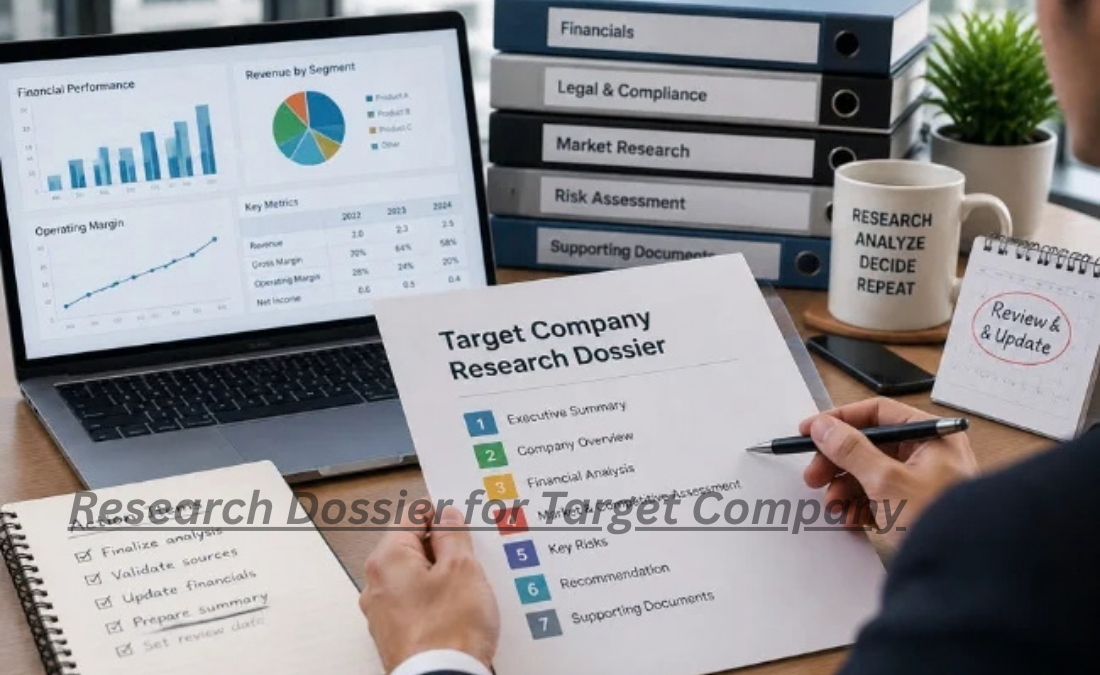
A research dossier for target company is a structured document that gathers important information about a business and presents it in an organized way. It can include the company’s history, ownership, leadership, products, financial performance, customers, competitors, market position, risks, opportunities, and recent developments.
The term “target company” simply means the organization being researched. It may be a public corporation, private business, startup, supplier, competitor, potential partner, or acquisition target.
A well-prepared dossier helps researchers understand a company using information collected from reliable and verifiable sources.
What Is a Research Dossier?
A research dossier is more detailed than a basic company profile. A company profile generally provides introductory information, while a dossier examines the business from several different perspectives.
A typical research dossier may contain:
- Company background
- History and milestones
- Ownership structure
- Leadership
- Products and services
- Business model
- Financial information
- Customers and markets
- Competitors
- Operations
- Technology
- Legal information
- Risks and opportunities
- Sources and evidence
The exact structure depends on the purpose of the research.
Why Is a Company Research Dossier Important?
Information about a company is often spread across many sources. The official website may describe its products, while financial information may appear in annual reports. News organizations may report on major developments, and government databases may contain registration or regulatory information.
A dossier brings these different sources together.
It can be useful for:
- Business research
- Investment analysis
- Competitor research
- Sales preparation
- Partnership evaluation
- Supplier research
- Market analysis
- Due diligence
- Acquisition research
- Academic projects
A structured dossier also makes it easier to identify information that is missing or difficult to verify.
1. Define the Research Objective
The first step is to determine why the company is being researched.
A clear objective prevents researchers from collecting large amounts of irrelevant information.
For example, the objective might be to understand the company’s business model, financial position, leadership, competitors, and future opportunities.
Different objectives require different research priorities. An investment report may emphasize financial performance, while a sales dossier may focus on products, customers, decision-makers, and recent expansion.
2. Company Overview
The company overview establishes the basic identity of the organization.
Important information includes:
- Official company name
- Brand name
- Official website
- Industry
- Headquarters
- Founding date
- Legal structure
- Main markets
- Parent company
- Subsidiaries
Researchers should confirm that they are investigating the correct company, particularly when businesses have similar names.
Official company websites, government records, regulatory filings, and established business databases can help verify company information.
3. Company History
The history section explains how the company developed over time.
Important milestones may include:
- Founding
- Major product launches
- Acquisitions
- Mergers
- Partnerships
- Geographic expansion
- Rebranding
- Leadership changes
- Major corporate developments
A simple timeline can make the company’s development easier to understand.
The purpose is not to document every event but to identify developments that help explain the company’s current position.
4. Ownership and Leadership
Ownership and management can provide important information about a company’s structure.
The dossier can identify:
- Founders
- Chief executive
- Senior executives
- Board members
- Major shareholders where publicly available
- Parent organizations
- Subsidiaries
For public companies, regulatory filings and investor-relations documents can provide detailed information.
For private companies, information may be more limited. Researchers should clearly distinguish confirmed information from estimates or unverified claims.
5. Products and Services
A research dossier should explain what the company sells or provides.
Researchers can examine:
- Main products
- Services
- Product categories
- Target customers
- Pricing where publicly available
- Distribution methods
- Geographic availability
It is also useful to determine what problems the company’s products or services are designed to solve.
Understanding the product portfolio helps explain the company’s position within its industry.
6. Business Model
The business model explains how the company generates revenue.
Common models include:
- Product sales
- Subscriptions
- Advertising
- Licensing
- Commissions
- Memberships
- Marketplace fees
- Software contracts
- Professional services
Researchers should determine which activities are most important to the business and whether the company depends heavily on a particular product, customer group, or geographic market.
7. Financial Performance
Financial information is an important part of many company dossiers.
Depending on availability, researchers may examine:
- Revenue
- Profit or loss
- Operating income
- Cash flow
- Assets
- Liabilities
- Debt
- Financial segments
- Historical performance
Every financial figure should include its reporting period.
A single number should not be used to describe the entire financial condition of a company. Revenue, profitability, debt, cash flow, and other indicators should be considered together.
8. Customers and Market
The dossier should identify the company’s primary customers and markets.
Research may cover:
- Consumer or business customers
- Geographic markets
- Customer segments
- Distribution channels
- International operations
- Major market categories
Understanding the customer base helps explain how the company competes and where its revenue may come from.
9. Competitor Analysis
Competitor research helps place the target company within its industry.
Researchers can compare the company with competitors based on:
- Products
- Services
- Pricing
- Technology
- Geographic reach
- Customer segments
- Distribution
- Marketing
A company may face different competitors in different countries or product categories, so competitor selection should be relevant to the market being studied.
10. Legal and Regulatory Information
Depending on the purpose of the research, the dossier may include publicly available legal and regulatory information.
This can include:
- Government actions
- Public lawsuits
- Regulatory investigations
- Intellectual-property disputes
- Product recalls
- Data-protection matters
- Corporate filings
Such information must be presented carefully. A lawsuit or allegation should not automatically be treated as proof of wrongdoing. Researchers should identify the source, date, status, and outcome when available.
11. Risks and Opportunities
A complete dossier should identify important factors that may affect the company’s business.
Potential risks include:
- Strong competition
- Regulatory changes
- Supply-chain problems
- Economic conditions
- Cybersecurity threats
- High debt
- Dependence on particular customers
- Technology changes
Potential opportunities may include:
- New markets
- Product expansion
- Strategic partnerships
- Increasing demand
- New technologies
- Geographic growth
These points should be connected to available evidence rather than unsupported assumptions.
12. Sources and Evidence
Reliable sourcing is essential.
Useful sources include:
- Official company websites
- Annual reports
- Regulatory filings
- Government databases
- Investor-relations pages
- Industry publications
- Reputable news organizations
- Business databases
Researchers should record the source, publication date, relevant information, and access date for important findings.
The dossier should also distinguish verified facts from estimates, interpretations, and unconfirmed information.
Frequently Asked Questions
1. What is a research dossier for a target company?
It is a structured report containing detailed information about a specific company, including its background, leadership, products, finances, customers, competitors, risks, opportunities, and supporting evidence.
2. What should a company research dossier contain?
It should normally include the company overview, history, ownership, leadership, products, business model, financial information, customers, competitors, legal information, risks, opportunities, and sources.
3. Who can use a company research dossier?
Investors, marketers, sales teams, researchers, business owners, consultants, students, suppliers, and companies evaluating potential partners or acquisitions can use a research dossier.
4. Are private companies suitable for research dossiers?
Yes. A dossier can be prepared for a private company, although financial and ownership information may be less publicly available than for a public company.
5. How often should a company dossier be updated?
It should be updated when important information changes, such as leadership, financial results, ownership, products, acquisitions, regulatory developments, or major market activity.
Conclusion
A research dossier for a target company provides a systematic way to understand a business. It combines company background, history, ownership, leadership, products, business model, financial information, customers, competitors, legal matters, risks, opportunities, and reliable sources.
The strongest dossiers use a clear research objective and distinguish verified facts from estimates and interpretations. Recording sources and dates also makes the research easier to verify and update.
Whether used for business development, investment research, competitor analysis, partnership evaluation, due diligence, or academic work, a well-organized research dossier provides a valuable foundation for understanding a target company and its position within its industry.